Information on Cuba
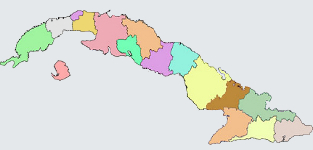
Cuba, the largest island of the Caribbean, is located at the entrance of the Gulf of Mexico. The closest countries are Haiti to the East (77 km), to the west the Yucatan Peninsula (210 km), to the north Florida (180 km) and to the south Jamaica (140 km). The Bahamas are pretty close, to the northeast of the eastern region. Cuba is made up of 4 195 keys and islands with a total area of 110 922 square km and 1 200 km long with a largely flat territory. Its nature, varied and generous, has a great variety of plants, animals and more than 280 beaches, virgin islands, caves, mountains, forests, savanna and swamps.
Climate
Due to its geographic location, in Cuba predominates the tropical climate with a marked sea influence, seasonally humid. The annual mean temperature is 25,4 Celsius degrees; in the eastern region it goes up to 26 Celsius degrees.
Flora and fauna
There are no plants or animals dangerous to men. There are around 900 species of fish, most of them edible. Almost 300 species of birds. Around 400 varieties of mollusk and almost 7 000 insect species and also some of the smallest species in the world with the small toad (Sminthillus limbatus) and the bee hummingbird (Mellisuga helenae). There are more than 8 000 species populating the vegetal world. Half og them are endemic. The sea flora and fauna are considered among the best preserved in the world.
Population
There are more than 11 million inhabitants in the Cuban population, in a peculiar mixture of Spanish, African and Asia population.
Language
The official language is Spanish.
Currency
The national currency is the Peso, equivalent to 100 centavos (cents). There are notes of 1, 3, 5, 10, 20, 50 and 100. The coins include 1, 2, 5 and 20 centavos and 1 and 3 pesos. There is also the peso convertible (CUC) that can be exchanged to foreing currencies according to the official exchange at the moment.
Electricity
Electric appliances using round pin attachment plugs should have an adapter plug for flat blade plugs cause those are the ones generally used in Cuban outlets. The general electricity used in the country is 110 V 60 Hz.
History
Cuba was discovered by Columbus on October 27 1492. Colonization caused the complete annihilation of the native population so slaves were brought from Africa. This mixture defined the Cuban culture and population. On October 10, 1868 started the independence wars against the Spanish domination that lasted four centuries. The United States of America intervened in the war and established a pseudo-republic in 1902 until January 1, 1959 when the Revolution lead by Fidel Castro triumphed with essential changes for the country's life.
State and Government
The National People's Power Assembly (Parliament) is the higher state power institution, represented by the Council of State between each session periods. It has provincial, municipal and district representations. The Council of Ministers is the higher administrative and executive institution and constitutes the government of the Republic of Cuba.
Political-Administrative Division and Main Cities
The country is divided in 15 provinces and one special municipality. The main cities according to their economic development and population density are: La Habana, antiago de Cuba, Holguín, Camagüey, Cienfuegos, Matanzas, Pinar del Río, Ciego de Ávila, Bayamo and Guantánamo.
National Symbols
The Flag
In 1850 what was to become the definitive national symbol was hoisted for the first time in the city of Cardenas (Matanzas). Encapturing simplicity
and perfect harmony, it combines three colors, red, white and blue, to form the Cuban flag: three blue stripes - the states in which the island was
divided at that time - two white stripes - the force of the idealistic independence fighter -, a red triangle - representing equality, fraternity and
liberty, and at the same time, the blood which had to be spilt during the battles for independence - and a white star, alone - as a symbol of the
absolute liberty between other nations - these are what characterize its beautiful design. At the start of the Independence War of 1868, Carlos Manuel
de Céspedes ordered to make another flag, which is the one standing next to the national one at the session room of the Cuban Parliament.
The Shield
The National shield represents our island. It is shaped like a pointed leather shield, and divided into three sections. In its
horizontal upper part, there is a golden key between two mountains, and a sun rising over the sea - which symbolises the position
of Cuba in the Gulf, between the two Americas, amidst the emergence of a new state. The blue and white strips, down the left hand
side, represent the situation of the island, in terms of its division into states, in the colonial period. Down the right hand
side, a Cuban country scene is dominated by a royal palm tree - the symbol of the unbreakable character of the Cuban people.
The National Anthem
The National Anthem was created in Bayamo, out of the fracas of the battle for independence. Pedro Figueredo, having composed
the melody in 1867, wrote the words to this battle hymn, with the sentiments of an independence figther, when the insurgent
took the city in 1868.
National Flower
The White Mariposa (Butterfly jasmine), a type of endemic jasmine, used by Cuban women in the independence wars to deliver
messages in war zones. It means purity, rebelliousness and independence. It grows on damp places like river banks and lagoons,
but is also grown in the gardens of many Cuban families.
National Tree
The Royal Palm Tree. Even though it is not native of Cuba, but is present in all the landscapes of the country and symbolizes
the unbreakable will of the Cuban people.
National Bird
The Tocororo (Cuban Tregor) (Priotelus temnurus). Native bird of the quetzal family having the colors of the flag on its
feathers.
Official Cuban commemorations
January 28: Anniversary of the birth of José Martí, Cuba's National Hero, in 1853.
February 24: Anniversary of the beginning of the War of Independence, in 1895.
March 8: International Woman's Day.
March 13: Anniversary of the attack to the Presidential Palace of Havana, by a group of revolutionary youths who sought to
execute the tyrant Fulgencio Batista, in 1957.
April 16: Proclamation of the Revolution's Socialist Character.
April 19: Anniversary of the defeat of the mercenary attack at the Bay of Pigs, in 1961.
July 30: Day of the Martyrs of the Revolution.
October 8: Anniversary of the death of Major Ernesto Ché Guevara, in 1967.
October 28: Anniversary of Major Camilo Cienfuegos's death, in 1959.
November 27: Commemoration of the execution of eight students of Medicine, by Spanish colonial government, in 1871.
December 7: Anniversary of Antonio Maceo's death in combat in 1896, an outstanding figure in Cuba's War of Independence
against the Spanish colonial rule.
Economy
Tourism is the main line. Other important industries are the sugar cane, tobacco, nickel, rum, coffee, and since a few years ago, the pharmaceutic and biotechnological lines.
Education
Education is free and obligatory until the ninth grade. In 1961, illiteracy was eradicated and today the population has a high instruction level. Cuba's national system of education comprehends from day care centers for working mothers' children to universities disseminated throughout the whole country.
Culture
A country prodigal in artistic and creative manifestations. It has made contributions to international culture with important names of writers, thinkers, dancers, musicians, painters, poets and singers. Cuban craftwork is interesting, with outstanding works in leather, vegetable fibers, wood, stone, metal and sea products. Cuba's cultural infrastructure consists of theaters, museums, art galleries and cinemas, where not only samples of the national wealth of all times are shown, but also of world art. It is the seat of important international events such as the Ballet Festival, the biennial of visual arts, popular music festivals and the Festival of the New Latin American Cinema, among others.
Health
Cuba's health system is said to have one of the world's most complete programs of primary attention, the lowest of infantile mortality rate in Latin America and free services for all the people.
Sports
Excellent olympic results, a highlighted place in world sports and the massive and free practice in the country make Cuba proud and are counted among the achievements of the people in the past 40 years.
Religion
Cuba characterizes for presenting a singular religious variety in which no specific religion prevail over others. Beliefs and religious practices are mainly identified as popular religiousness and are the result of racial interbreeding and cultural synthesis forming Cuban nationality.